SUPREME COURT AT GLANCE
1.0 Composition of the Supreme Court
- On 23rd June 2022, the Supreme Court marked eleven (11) years since its inception.
- The Court is established under Article 163 of the Constitution comprising of seven (7) members: namely the Chief Justice, who is the President of the Court; the Deputy Chief Justice, who is the Vice President of the Court; and five other Justices of the Supreme Court.
- After the promulgation of the Constitution 2010, an Act of Parliament had to be first enacted to operationalize the Supreme Court as provided under Article 163(9) of the Constitution. This statute is the Supreme Court Act, 2011, assented to on 22nd June 2011, and commenced on 23rd June, 2011.
1.2 History of the Supreme Court
- The roots of the modern judiciary in Kenya can be traced back to the era of the East African Protectorate (1895-1920). The Imperial British East African Company (IBEAC) introduced the British legal system to the East African region and this was based on the British Common Law. In 1895, Kenya became part of the British East Africa Protectorate and it was declared a Crown Colony in 1920. Meanwhile, as a result of the Brussels and Berlin Conferences of 1884 to 1887, judicial systems were established in the British Colonies. Hence, via the 1897 East Africa Order in Council and the Native Courts Regulations, 1897, there was established a two-court system in the British East Africa Protectorate: the Native Courts and the Non-African Courts. The 1902 East Africa Native Courts (Amendment) Ordinance established Special Courts with full criminal and civil jurisdiction for natives in the Districts. The High Court of East Africa applied English law, while the Native Courts used customary law. In 1907 the Native Courts Ordinance established a tri-patriate division of the African Courts: Native Courts Tribunals, Chiefs & Headmen, and Council of Elders.
Supreme Court under the Independence Constitution
- On 1st June,1963 Kenya attained internal self-rule from the British Colonial powers and on 12th December 1963 gained independence and became a Republic. The Independence Constitution provided for a Judiciary made up of subordinates Courts, the Supreme Court, the Court of Appeal and the Judicial Committee of Britain’s House of Lords.
- The Supreme Court was established with original and unlimited civil and criminal jurisdiction and could also handle constitutional interpretation and matters relating to enforcing fundamental rights. It was to be made up of the Chief Justice and not less than eleven other Judges. The Chief Justice was appointed by the Governor-General in consultation with the Prime Minister, who was enjoined to consult with all the Presidents of the regional assemblies, at least four of whom had to support the candidate. The Governor General also appointed other judges in consultation with the Judicial Service Commission and other puisne judges.
- The Constitution envisaged a Court of Appeal to hear appeals from the Supreme Court on all matters, including the interpretation of the Constitution and enforcement of fundamental rights and freedoms. However, there was no Court of Appeal of Kenya, but the East Africa Court of Appeal was the apex Court in the entire East Africa and served as the Appeal Court for all three East African Countries until it was dismantled in 1977. In 1965, through the Constitution of Kenya (Amendment) Act No. 14 of 1965, the Supreme Court was renamed to be the High Court.
Constitution making process
- The birth of the Supreme Court of Kenya under the Constitution 2010 is well traced within the Constitution making process, which process began with the Constitution of Kenya Review Commission (CKRC), set up in 2000 that produced a Draft Constitution in September 2002, famously referred to as the Ghai Draft.
- The Final Report of the Constitution of Kenya Review Commission (CKRC Report), published on 10th February, 2005 provides the purpose for the establishment of the Supreme Court. On the Court system, the Report noted thus:
“Serious allegations were made against the Judiciary, including inefficiency, incompetence and corruption. Besides, it was fairly evident that the people had lost faith in the Judiciary’s ability to dispense justice fairly, impartially and without fear. Similar sentiments had been expressed by a committee established by the Judiciary itself – the Kwach Report and a Report by Commonwealth Judicial panel of experts.”
- The Commission took note of the views of the people of Kenya regarding the structure of the Courts noting that the majority articulated the need to establish a constitutional court, supreme court and village tribunals. At pages 77 and 78 of the CKRC Report the Commission noted that the people raised concerns regarding the general restrictive approach to constitutional interpretation which the High Court had adopted and its decision being made against public interest. Complaints were also raised about the lack of a right of appeal from a High Court decision on constitutional matters; this was seen as a denial of the right of appeal of the aggrieved party. Some High Court decisions were further criticized for being made against the public interest and being influenced by factors outside the law. The people were of the view that a Supreme Court should be created and that such a court should have power to issue Advisory Opinions.
- Due to these concerns, among the recommendations by the Commission was the constitution of the Supreme Court as the final arbiter on interpreting the Constitution. The Technical working committees upon consideration of the issues bedeviling the Judiciary recommended recommended that the Supreme Court whose functions are to-
- arbitrate over Civil and Criminal cases;
- act as a referral court in issues arising from disputes between districts and provincial councils;
- act as the final court of appeal in all matters;
- give advice to the executive or parliament on the interpretation of the Constitution;
- solve disputes arising from presidential elections; and
- Exercise original jurisdiction as provided by Constitution and by legislation.”
- The CKRC then convened a National Constitutional Conference at Bomas of Kenya (the Bomas Conference) for deliberations on a new Constitution on the basis of the Ghai Draft and produced the Bomas Draft.
- Chapter 13 of this Draft dealt with ‘Judicial and Legal System’ and Article 184(2) provided that the superior courts of record were the Supreme Court, Court of Appeal and the High Court.
- It is important to note that in the Bomas Draft, the Supreme Court did not have the jurisdiction to render Advisory Opinion, currently provided in Article 163(6) of the Constitution; while under the Constitution 2010, the Supreme Court lacks the jurisdiction to determine disputes relating to impeachment of the President that was provided in the Bomas Draft.
- The Bomas Draft was followed by the Wako Draft which was published on 22nd August 2005. As regards the judiciary, the Wako Draft did not differ much from the Bomas draft, the provisions as regards the Supreme Court remained intact. A notable inclusion though was the provision for Traditional Courts.
- On 17th November, 2009, the Committee of Experts published a Harmonized Draft Constitution having collated all the previously existing drafts. In this Harmonized Draft, Article 200(1) provided that ‘the superior courts are the Supreme Court, the Court of Appeal, the Constitutional Court and the High Court’. As regards the jurisdiction of the Supreme Court, Article 201 provided as follows:
“(4) The Supreme Court has—
(a) exclusive original jurisdiction to hear and determine disputes arising from the process of the impeachment of the President; and
(b) subject to clause (5) and (6), appellate jurisdiction to hear and determine appeals from—
(i) the Court of Appeal and the Constitutional Court; and
(ii) any other court or tribunal as prescribed by an Act of Parliament.
(5) No appeal may lie from the Constitutional Court to the Supreme Court in respect of a decision concerning a presidential election petition.
(6) Appeals lie from the Court of Appeal to the Supreme Court—
(a) as of right in any case involving the interpretation or application of this Constitution; and
(b) in any other case in which the Court of Appeal or the Supreme Court certifies that a matter of general public importance is involved.
(7) The Supreme Court shall not be bound by its previous decisions if it considers it is in the interests of justice and the development of the law for it not to be so bound.
(8) Despite the provisions of clause (2), a decision made in accordance with clauses (4)(a) and (7) may be made only by a sitting of the Court in which all of the judges of the Supreme Court sit.
(9) All other courts shall be bound by the decisions of the Supreme Court.”
- Notably, when the Proposed Constitution was published, the Constitutional Court had been deleted and some of its mandate transferred to the Supreme Court as is in the new Constitution. The Report of the Parliamentary Select Committee on the Review of the Constitution on the Revised Harmonized Draft Constitution dated 29th January 2010 noted in this regard, that:
“4.12 Chapter Eleven: Judiciary
The Chapter on Judiciary was not considered contentious by the Committee of Experts although Judiciary is one arm of Government that has raised concern among the public in its dispensation of justice and the question of its independence. The Committee deliberated on the Chapter and made to remove clauses which could be addressed through legislation.
One of the most notable modifications in the Chapter is the removal of the Constitutional Court from the Harmonized Draft as it was considered an ad hoc institution (formed when need arises) and that its functions will best be performed by the Supreme Court…”
- The Proposed Constitution was thereafter subjected to a Referendum that culminated in the promulgation of the new Constitution on 27th August, 2010.
- As a result, the Constitution of Kenya 2010, which was popularly supported through a referendum, established the Supreme Court as the highest court in the land, a final arbiter on interpreting the Constitution; and with exclusive original jurisdiction in respect of presidential election petitions.
1.3. Jurisdiction of the Supreme Court
- The Supreme Court’s jurisdiction is set out under Articles 58(5), 163(3), (4), (5) & (6), 168(8) of the Constitution and Sections 12, 13, 15, 29, and 40 of the Supreme Court Act No. 7 of 2011 Laws of Kenya, as follows, to: –
- Exclusively hear and determine disputes relating to the Presidential elections.
- Hear and determine appeals from the Court of Appeal:
- as of right where the case involves interpretation or application of the Constitution.
- where the Supreme Court or the Court of Appeal certifies that a matter of general public importance is involved. A certification by the Court of Appeal may be reviewed by the Supreme Court and either affirmed, varied, or overturned.
- Hear and determine Appeals from any other court or tribunal, as prescribed by national legislation.
- Render Advisory Opinion at the request of the National Government, any State organ, or any County Government, with respect to any matter concerning County Government.
- Determine the validity of: –
- a declaration of a state of emergency;
- an extension of such declaration and
- any legislation enacted or action taken in consequence of a declaration of a state of emergency.
- Hear and determine appeals against a tribunal’s recommendation to remove a Judge.
- The Seat of the Court and History of the Supreme Court Building
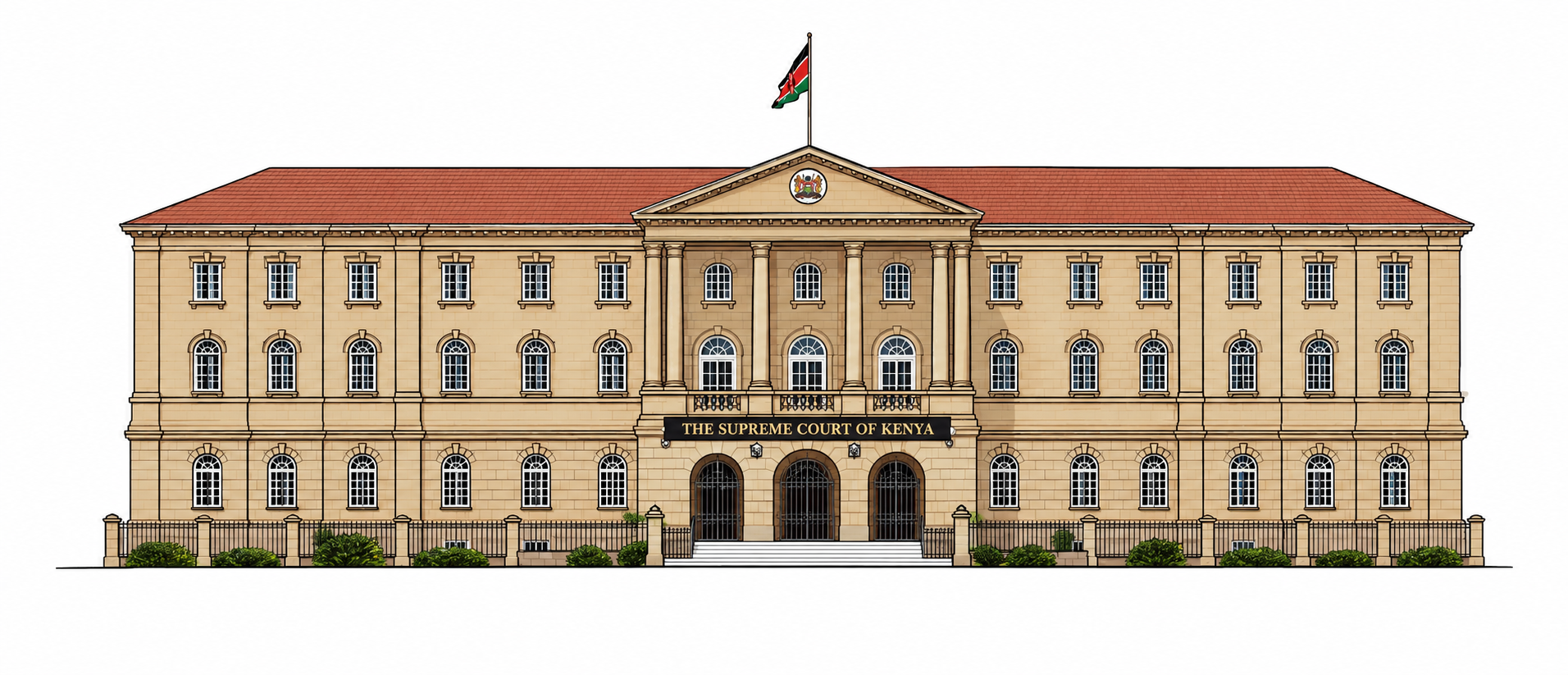
- The seat of the Supreme Court of Kenya is in the Supreme Court Building in Nairobi. The Supreme Court of Kenya sits at the intersection of Taifa Road and City Hall Way in the capital city of Nairobi. It is located in the Central Business District, next to the Kenyatta International Conference Centre (KICC), and the Office of Governor of the Nairobi County Government. The building has three floors and a basement. It can be accessed via two gates: the main gate on City Hall Way and the other on Taifa Road, opposite Kenya Re Plaza. Other gates for special access exist.
- The Supreme Court Building is a classic example of colonial administration architecture. The building was designed in 1929 by Sir Herbert Baker in a neo classical style. The foundation stone was laid by Sir Edward Grigg, Governor of Kenya colony on 7th July 1930 and was built in 1931. It has played host to many high-profile visitors including Hilary Clinton, who visited in 2012 as Secretary of State, and H.E Kofi Annan, who visited several times.
- The building is of national heritage value by virtue of its rich history and architecture. On 1st December, 1995 it was classified as a national monument under the Antiquities and Monuments Act. The basement containing the police cells was renovated and now houses the Judiciary Museum, which is open to the public.
- Outside the main public entrance is the “Hamilton Fountain”, which is a bronze statue of a blind naked boy holding a large fish. The statue was put up during the reign of Sir Robert Brooke, a Kenyan British colonial government governor in honour of lawyer Alexander George Hamilton, a man who stood for justice and died in 1937.
- The statue, which was commissioned by the lawyer’s wife, Gertrude Hamilton, is meant to portray justice as blind, naked and slippery and at the same time as fearless as a boy.
- The building’s usage has changed over time. It originally housed the Provincial Headquarters, offices of; the Inland Revenue, Chief Justice, Registrar, East African Court of Appeal and the High Court. The Court rooms and Magistrates’ chambers occupied the ground floor. The basement had police and prison cells to hold offenders before they appeared for their hearings.
- After independence, the Provincial Headquarters and the Inland Revenue Office were moved to the Old Jogoo House. The building was then renamed “The High Court”.
- Currently, it is the official seat of the Chief Justice, the Deputy Chief Justice, the Chief Registrar and the Supreme Court alongside the Court of Appeal and various Directorates.
- The building is a national heritage by virtue of its rich history and architecture. On 1st December, 1995 it was classified as a national monument under the Antiquities and Monuments Act. The basement containing the police cells was renovated and now houses the Judiciary Museum, which is open to the public.